
FOREST
CONCESSIONS
Understand all the key points

Forest concessions are an instrument of Brazilian public policy that allows the sustainable use of public forests by companies or cooperatives, under pre-established rules and timelines, and subject to strict oversight. Their goal is to ensure the generation of economic and social development without harming the environmental integrity of forests.
In practical terms, it is a model in which the State authorizes the planned, legal, and responsible use of the forest for the production of timber, oils, seeds, fruits, and other biodiversity products—always in compliance with technical criteria, extraction limits, and previously approved forest management plans. It also includes a concession modality for the restoration of degraded areas, as a mechanism for providing environmental services.
WHY ARE THEY IMPORTANT?

HOW DO THEY WORK?
The process is led by the Brazilian Forest Service (SFB) and involves:

Forest concessions are more than a contract: they are a pact for the future.
By bringing together conservation, the economy, and local development, this public policy shows that it is possible to produce while keeping the forest standing—and that Brazil can lead the way toward a sustainable and inclusive economy.
TYPES OF FOREST CONCESSIONS
There are two main formats:
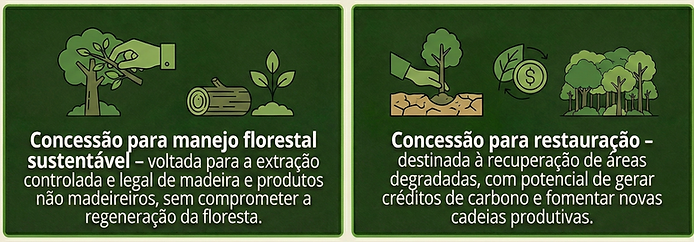

RESTORATION IN THE CONTEXT OF FOREST CONCESSIONS
In Brazil, forest concessions for restoration are a new type of public contract that enables the recovery of degraded areas of public forests, with clear goals, timelines, and obligations for concessionaires. As with forest management concessions, the process is led by the Brazilian Forest Service (SFB) and involves public bidding and continuous oversight.
This model ensures that restoration does not rely solely on public or voluntary funding, but also becomes an economically viable activity—integrating the potential generation of carbon credits, sustainable production, and the creation of local jobs.
Social, economic, and environmental benefits of restoration concessions:

THE FIRST FOREST CONCESSION FOR RESTORATION


The Bom Futuro National Forest (Flona), located in Rondônia, is becoming the inaugural milestone of this model in Brazil. The area, which has experienced significant deforestation over recent decades, is being prepared to receive a concession contract dedicated exclusively to forest restoration.
The project includes:
-
Restoration of thousands of degraded hectares with native species.
-
Development of a business model that combines restoration, carbon credits, and complementary sustainable activities.
-
Engagement of local communities and companies across the entire value chain, from nurseries to post-planting monitoring.
-
Rigorous monitoring to ensure targets are met and forest regeneration is achieved.
The Bom Futuro Flona experience will serve as a reference for other restoration concessions planned under the Forest Granting Multiannual Plan (PPAOF) 2024–2027, helping Brazil consolidate a model capable of restoring large areas with scale, security, and multiple benefits.
WHAT IS THE PURPOSE OF THIS SPACE?
To promote transparency, engagement, and innovation in the forest concession agenda, making the topic accessible to diverse audiences—from public managers and researchers to local communities, entrepreneurs, and citizens interested in conserving the Amazon and other biomes.