
Partnership with the Brazilian Forest Service will boost forest concessions in the Amazon

The objective is to expand the area of federal forests dedicated to management and restoration activities, generate social benefits, and help combat land grabbing.
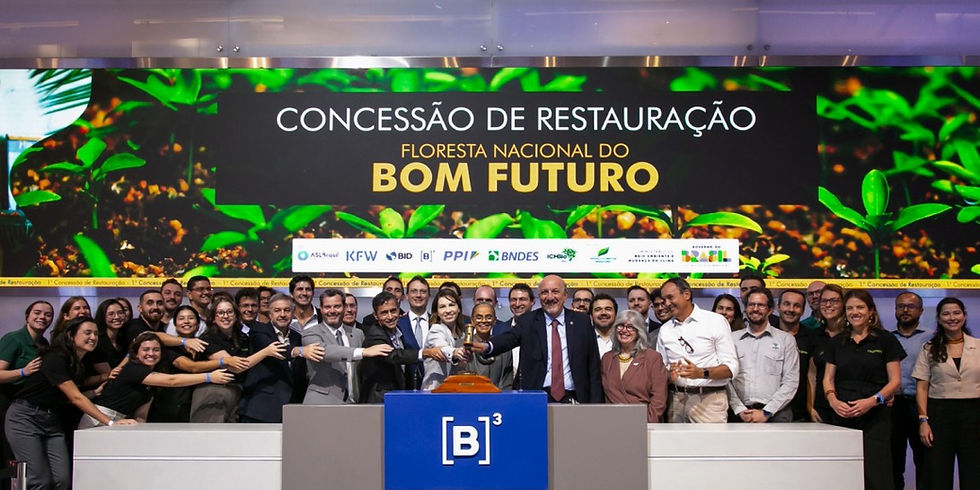
The Institute for Forest and Agricultural Management and Certification (Imaflora), the Brazilian Forest Service (SFB), and the consultancy Systemiq launched today (July 23) a partnership to promote forest concessions for management and forest restoration in the Amazon. The goal is to reach 5 million hectares within the next two years—an area comparable to the territory of Costa Rica and more than triple the current 1.3 million hectares under this regime.
The partnership aims to develop financial models, conduct technical studies, support the distribution of concession revenues to states and municipalities, encourage the implementation of policies focused on community forest management, and produce communication materials on the topic. It is funded by the UK government through UK PACT (Partnering for Accelerated Climate Transitions), the main climate action program of the UK’s International Climate Finance (ICF).
Forest management allows for the selective harvesting of trees for timber purposes, with or without the simultaneous use of non-timber products (such as nuts, oils, extracts, and tourism). “Forest restoration, a newly introduced modality, will be primarily financed through the sale of carbon credits by the concessionaire,” explains Renato Rosenberg, Director of Forest Concessions and Monitoring at the SFB. The project’s bidding notice is currently under review by the Federal Court of Accounts and will include specific funding from the Inter-American Development Bank (IDB) and BNDES. Still in July, a market consultation on the bidding notice is scheduled for July 25.
Financial and environmental benefits
The 23 concessions currently in force are at different stages of implementation, and 16 had begun production by 2022, when the activity generated R$ 33.5 million in timber products (400,000 cubic meters of logs), according to SFB data. With expansion, by 2026 these figures are expected to reach 1.8 million cubic meters of logs, valued at R$ 184 million.
This performance is associated with the creation of approximately 7,000 direct jobs and 14,000 indirect jobs, as well as social investments totaling around R$ 15 million. In addition, public revenues of approximately R$ 45 million are expected, part of which is distributed to the states and municipalities hosting the concessioned forests.
“Today, there is a transfer of R$ 14 million derived from federal concessions to the state of Pará alone. Some municipalities exceed R$ 3 million. To understand the impact of this revenue, it’s important to remember that we are talking about locations with some of the lowest Human Development Indexes in the country. The challenge is unlocking the use of these resources so they translate into real benefits for local communities,” said Leonardo Sobral, Forest Director at Imaflora.
There is also a key environmental benefit: the conservation of forests and their biodiversity. “Forest management follows strict parameters, with maximum extraction volumes per hectare and 30-year cycles for forest regeneration. This activity ensures that these areas are no longer ‘no man’s land,’ as is the case with most undesignated forests—those that are not Indigenous lands, reserves, or conservation units,” Sobral added.
According to Felipe Faria, Nature Director at Systemiq, integrating the carbon market into this agenda—combined with forest management and restoration at scale—represents a significant step forward, creating new financing opportunities and incentives for forest conservation. “We see valuing standing forests as a central strategy, and by providing these new economic tools, we are laying the foundation for sustainable development that benefits both local communities and the global environment. Together, we can transform Amazon conservation into a model of economic and environmental prosperity,” he stated.
Breaking the cycle of deforestation and illegal occupation is fundamentally an economic issue: the forest must be worth more standing than cleared. “Forest management is clearly the best example of a scalable economic activity capable of protecting forests while generating jobs, income, social opportunities, and economic formalization. This agenda has a track record of positive results, but it needs to be accelerated,” Rosenberg emphasized.
Producing to conserve
It may seem counterintuitive that allowing tree harvesting can help protect standing forests—but that is exactly what happens. Concession operations require detailed management plans specifying what will be extracted and where. These plans are preceded by forest inventories that assess species stocks.
Typically, one hectare of tropical forest contains around 200 mature trees and another 1,000 younger trees. Under management rules, only five to six trees per hectare can be harvested every 30 years. This harvesting is selective and planned—it excludes protected species, such as Brazil nut trees; older trees that serve as seed sources; and younger trees still in growth stages. Entire populations of a single species are never removed, ensuring biodiversity is maintained.
Over the following three decades, the area regenerates. Satellite imagery shows that within about ten years, the forest is largely restored, including areas of secondary roads opened for extraction. This is followed by another twenty years of recovery, without compromising biodiversity or key environmental services such as water regulation and carbon sequestration.
Control mechanisms
The SFB uses a chain-of-custody system that includes multiple procedures to ensure compliance with management plans. Each harvested log receives a QR code containing key information—species, dimensions, and location within the plan—essentially functioning as a fingerprint for that tree. Complementing this is the Selective Logging Detection System (Detex), developed with Brazil’s National Institute for Space Research (INPE), which uses satellite monitoring every two weeks to detect any degradation beyond planned levels.
Drones are also used to verify timber volumes during harvesting, transport, processing, and sale stages, ensuring consistency across the supply chain. If a volume exceeds what was legally harvested, it may indicate the inclusion of illegal timber.
Additionally, a radar-based system known as Light Detection and Ranging (Lidar) is used to precisely monitor forest regeneration after harvesting.
Ending illegality
The forest concession agenda has strong potential for expansion to prevent further devastation of the Amazon. It is estimated that 25 million hectares under permanent forest management would be sufficient to eliminate illegality in the timber sector. While this may seem ambitious, it represents less than half of the 60 million hectares of undesignated public forests (federal and state), which are the most vulnerable to environmental crimes.
According to Imaflora, this estimate is based on the area required to produce the equivalent of all legally traded timber in the country, around 8 to 10 million cubic meters per year.
The Timberflow platform—developed by Imaflora to guide timber buyers, among other uses—shows that between 2010 and 2023, 77 million cubic meters of timber were produced, 8% of which was exported. Although around 1,000 species are commercially exploited, eight account for 50% of exports: ipê, tauari, maçaranduba, jatobá, red angelim, garapeira, cumaru, and red tauari. “The concentration of demand on a few species indicates pressure on them, and once again, the concession and forest restoration model can help by improving planning for the balanced use of these resources,” Sobral concluded.


Comments