
What is the status 17 years after the creation of the Public Forest Management Law?

The 17th anniversary of the Public Forest Management Law (LGFP), enacted through Federal Law No. 11,284/2006, is a legal milestone that invites reflection on the challenges of its implementation, particularly regarding the expansion and consolidation of forest concessions in Brazil. After 17 years, the LGFP has yet to achieve the necessary scale, both in increasing supply and in contributing effectively to combating predatory and illegal activities.
In this context, the Amazon rainforest continues to suffer from the lack of allocation of public lands for forest concessions. A survey by the Simex network (Timber Exploitation Monitoring System), using satellite imagery, mapped 377,000 hectares of logged areas in the Amazon between August 2020 and July 2021 and found that 142,000 hectares—38% of the total—were subject to unauthorized logging. This means that, in just one year, illegal logging in the Amazon reached an area comparable to the city of São Paulo. Forest concessions are an environmental policy tool that can help reverse this situation by promoting sustainable forest management.
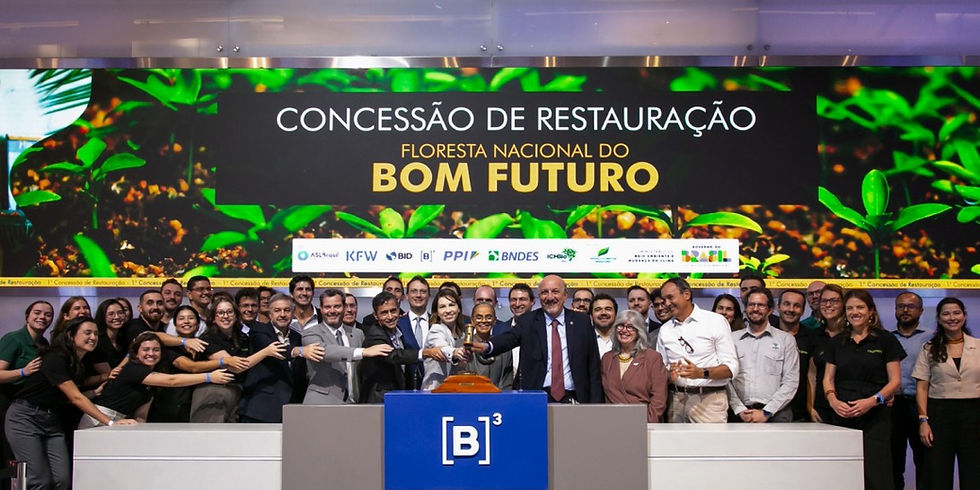
In 2020, a coalition of more than 340 representatives from the private sector, financial institutions, academia, and civil society—known as the Brazil Climate, Forests and Agriculture Coalition—extensively discussed a bill aimed at boosting forest concessions. Bill No. 5,518/2020, which seeks to improve the Public Forest Management Law (Law 11,284/2006), is currently under review in the Chamber of Deputies.
Between 2010 and 2021, forest concessions generated R$ 125.9 million, according to data from the Brazilian Forest Service compiled by Imaflora. Most of this revenue comes from timber. Even so, some concessionaires have returned concessions because the business model is not financially viable. One of the goals of Bill No. 5,518/2020 is to increase the economic attractiveness of concessions by promoting diversification of activities based on forest products and environmental services, consolidating them as a driver of job creation and income while countering deforestation and illegal activities.
The bill also aims to expand permission to commercialize carbon credits and other environmental services, allowing access to genetic resources, provided that Brazil’s Biodiversity Framework is respected. While this topic remains under discussion and the bill has not yet been approved, Provisional Measure No. 1,151/2022 was issued in 2022, introducing mechanisms for the development and commercialization of carbon credits and environmental services not only in national forests but also in other types of conservation units. The measure is currently under consideration in Congress to become a permanent amendment to the law.
Over 16 years of the LGFP, only 1.6 million hectares of concessions have been implemented at the federal and state levels—an average of 100,000 hectares per year. To reach the scale needed to effectively control deforestation and degradation of public lands, the target is 25 million hectares within 10 to 15 years. Achieving this would require implementing 1.6 million hectares per year—16 times the current rate.
Another key challenge for the future is improving communication and transparency across all stages and among all stakeholders, clearly presenting the benefits of concessions, the roles of different actors, and their potential contribution to national development.
Establishing institutional arrangements that more equitably consider the interests of all stakeholders and bring decision-making closer to both local and federal levels will be essential for scaling up sustainable timber management from legal sources and transforming the sector and its perception.
Despite progress over the past 17 years, significantly greater commitment from key stakeholders is still required to reach the goal of 25 million hectares under forest concession, enabling Brazil to sustain the production of 10 million cubic meters of timber—current levels—while combining job creation, social development, and sustainability in the forestry sector.


Comments